







You wake up with a sore jaw. Your ear feels blocked, but your doctor says everything looks fine. You hear a click every time you open your mouth wide. Sound familiar?
These are classic signs of a temporomandibular joint (TMJ) disorder, a condition that affects the joints connecting your jawbone to your skull. And yet, many people suffer for months before getting the right diagnosis.
TMJ disorders affect approximately 5–12% of adults globally, with women between the ages of 20 and 40 being significantly more affected than men. In a high-stress urban environment stress-induced jaw clenching is becoming an increasingly common trigger.
The good news? With the right approach, TMJ pain can be managed effectively, and in many cases, reversed. Here are the relief strategies that are backed by clinical evidence and actually deliver results.
TMJ pain can significantly affect daily activities like eating, speaking, and even sleeping. While long-term treatment focuses on correcting the root cause, there are several quick relief strategies that can help reduce discomfort almost immediately. These methods are simple, effective, and often recommended by dental professionals for short-term relief.
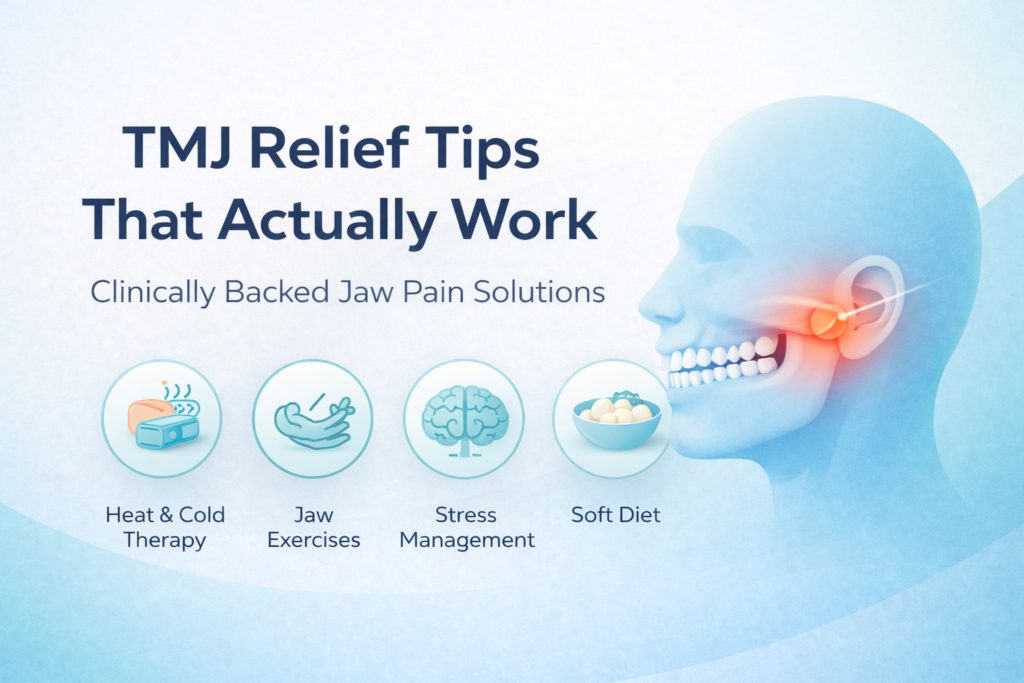
One of the most common questions patients ask is: Is heat or ice better for TMJ? The answer depends on the stage of your symptoms.
Heat therapy (warm compresses or a heated pad applied for 15 minutes) is most effective for chronic jaw stiffness and tight facial muscles. Heat increases blood flow, relaxes the surrounding muscles, and reduces muscle guarding, a key driver of TMJ-related pain.
Cold therapy (ice wrapped in a cloth, not directly on skin) works better for acute flare-ups, post-procedure soreness, or when the joint area feels swollen or inflamed. Cold reduces nerve conduction and temporarily numbs the area, offering quick pain relief.
Alternating heat and cold, 10 minutes each , can be more effective than using either alone for sub-acute TMJ pain.
Targeted TMJ exercises help restore normal jaw movement, reduce muscle tension, and prevent joint stiffness. These are not the same as random jaw stretches , they should be done slowly and with precision.
Avoid exercises that cause pain or loud clicking. Start with 5 repetitions and gradually increase. Your TMJ specialist can tailor a programme specifically to your bite pattern and joint health.
Bruxism (teeth grinding) is one of the most destructive, and under-treated, contributors to TMJ disorders. Most people grind their teeth at night without knowing it, waking up with jaw soreness, headaches, or worn-down teeth.
A custom-fitted night guard, GNM Orthotics for TMJ is one of the most effective non-surgical TMJ treatments available. Unlike over-the-counter mouth guards, a specialist-fitted appliance is designed based on your specific bite relationship and jaw position.
How it works: – GNM Orthotics repositions the disc and jaw alignment – thereby reducing joint loading, taking pressure off the TMJ disc and surrounding muscles.When muscles are in their happy place, teeth grinding reduces.
A flexible night guard can actually worsen TMJ symptoms as it increases teeth clenching. Always have one made by a TMJ-trained dentist, not a pharmacy.
In clinical practice, patients dealing with high occupational stress, anxiety, or poor sleep consistently show higher rates of TMJ symptom severity. Techniques such as biofeedback, cognitive behavioural therapy (CBT), mindfulness-based stress reduction (MBSR), and even structured breathing exercises have been shown to reduce jaw clenching and TMJ pain scores.
What you eat matters more than most people realise when managing jaw pain relief. Hard, chewy, or crunchy foods place significant mechanical load on the TMJ, triggering inflammation and prolonging recovery.
| Aspect | Temporary / Home Relief | Specialist TMJ Treatment |
| Goal | Reduce immediate pain | Address root cause |
| Duration of relie | Hours to days | Long-term or permanent |
| Examples | Ice packs, soft diet, rest | GNM orthotics, Occlusal splints, physical therapy, bite correction |
| Treats bruxism? | No | Yes |
| Treats joint damage? | No | Yes |
| Risk if used alone | Symptoms return or worsen | None, when monitored by specialist |
| Best for | Mild or occasional discomfort | Moderate to severe or chronic TMJ disorder |
TMJ pain is real, manageable, and in most cases, treatable without surgery. But self-treatment has its limits, especially when symptoms are persistent, worsening, or affecting your quality of life.
Dr. Ankita Shah is a dedicated TMJ specialist in Mumbai offering evidence-based, personalised care for jaw pain, bruxism, jaw clicking and popping, and related disorders. With a comprehensive assessment and a tailored treatment plan, lasting relief is within reach.
Book a Consultation with Dr. Ankita Shah
TMJ pain duration varies widely depending on the underlying cause. Mild cases triggered by stress or temporary muscle strain may resolve within 2–4 weeks with home care. Moderate to severe cases involving joint disc displacement or structural abnormality can persist for months or years if left untreated.
Both have their place, the choice depends on your symptoms. Use heat (warm compress for 15 minutes) for chronic muscle tightness, jaw stiffness in the morning, and general soreness. Use ice (wrapped in cloth, not directly on skin) for acute pain, inflammation, or swelling after a flare. For ongoing management, alternating both can be effective.
Yes ,and this is one of the most commonly missed TMJ symptoms. The temporomandibular joint sits just in front of the ear canal, and inflammation or disc displacement in this joint can cause referred pain that feels exactly like an ear infection or inner ear problem. If you have recurring ear pain without infection, jaw clicking, or difficulty chewing, a TMJ evaluation is strongly recommended.
Yes, but only if they are properly fitted by a qualified TMJ specialist. A custom occlusal splint or GNM Orthotics for TMJ works by repositioning the jaw, reducing grinding pressure, and allowing the jaw muscles to relax overnight. At our TMJ treatment clinic, every night guard is fabricated using digital bite records for maximum precision.
In many cases, yes, with the right treatment plan. Mild to moderate TMJ disorders caused by muscle dysfunction, bruxism, or bite misalignment often respond very well to non-surgical treatment. A combination of a customized GNM splint, physiotherapy, dietary changes, and stress management can produce long-lasting relief. However, in cases involving structural joint damage or advanced degeneration, ongoing management may be needed.
Untreated TMJ disorder does not simply stay stable, it tends to worsen over time. Chronic joint inflammation can lead to articular disc deterioration, cartilage breakdown, and in severe cases, bone-on-bone contact within the joint. Patients may experience progressively limited mouth opening, worsening facial muscle tension, chronic headaches, and bite changes. Teeth may also wear down significantly from unaddressed bruxism.
The most effective non-surgical TMJ treatment is typically a multimodal approach, meaning multiple therapies used together. This includes a custom-fitted occlusal splint, GNM Orthotics night guard, targeted physiotherapy and jaw exercises, dietary modifications, and stress management strategies. For patients with bite-related TMJ dysfunction, orthodontic correction or dental equilibration may also be recommended. Surgery is only considered when conservative treatment has failed and imaging confirms structural joint damage.
Copyright ©2025 TMJ, Tongue Tie and Sleep Institute. All Rights Reserved.
WhatsApp us
Let Us Know How Can We Help You!
At our institute, we take pride in providing complete care for issues related to tongue tie and TMJ. To enhance your quality of life, we treat a range of ailments with state-of-the-art technology and expert care. If you’re searching for an effective tongue-tie operation option or a TMJ specialist in India, you have arrived at the right place.
A tongue tie operation or tongue tie surgery is a life-changing procedure that not only restores tongue mobility but also has a full body effect. While most people associate tongue tie with breastfeeding difficulties in infants, it can also affect speech, breathing, posture, dental health, and sleep patterns in older children and adults. By undergoing this minimally invasive fascia release procedure, patients often experience immediate improvements in functionality and overall well-being.
For individuals considering tongue tie surgery, the benefits are far-reaching:
The Temporomandibular Joint (TMJ) that is your Jaw Joint has a significant impact on one’s quality of life, as they leave the person feeling exhausted and irritable. It not only affects essential functions like chewing, speaking, yawning but also affects one’s posture, breathing and sleep. As a leading TMJ specialist in Mumbai, we offer comprehensive diagnostics and personalized treatment plans to address your unique needs.
Our approach to TMJ disorders combines state-of-the-art technology with evidence-based practices. We specialize in:
Many patients are unaware that tongue tie and TMJ disorders can also be interconnected. A restricted tongue can lead to compensatory behaviors that strain the jaw, progressing towards TMJ issues.
For newborns, a tongue tie operation is critical in supporting breastfeeding. Infants struggling to latch or feed effectively benefit greatly from a quick and safe procedure.
Adults often seek tongue tie operations for relief from symptoms such as speech impediments, TMJ pain, or even snoring. Combining tongue tie surgery with myofunctional therapy ensures optimal results.
An integral part of our treatment protocols is myofunctional therapy. Exercises used in this therapy help to strengthen and coordinate the muscles of the tongue and face. Whether you’re undergoing a tongue tie operation or being treated for TMJ issues, myofunctional therapy plays a pivotal role in ensuring lasting outcomes. Expertise and complete treatment are essential for treating TMJ issues or tongue tie. Whether you’re searching for the best tongue tie surgery options or a trusted TMJ specialist in Mumbai, we ensure personalized care and transformative results. Don’t let these conditions stop you—reach out to us today to book your consultation and start your journey toward better health and wellness.