






Athletes and fitness enthusiasts push their bodies hard. This also places significant strain on the jaw. Clenching during lifting, impact to the face in contact sports, long hours of training, forward-head posture, and high stress can overload the temporomandibular joint (TMJ).
When this joint and its surrounding muscles are not in balance, athletes may notice jaw pain, clicking, headaches, neck pain or shoulder stiffness, tightness around the ears and temples, or even a drop in performance.
This imbalance often results in a change in overall posture, affecting balance, coordination, and athletic performance.
The good news: TMJ problems are treatable with the right, guided, neuromuscular approach.
TMJ disorder is a dysfunction of the jaw joint and the muscles that control jaw movement. In athletes, this commonly presents as:
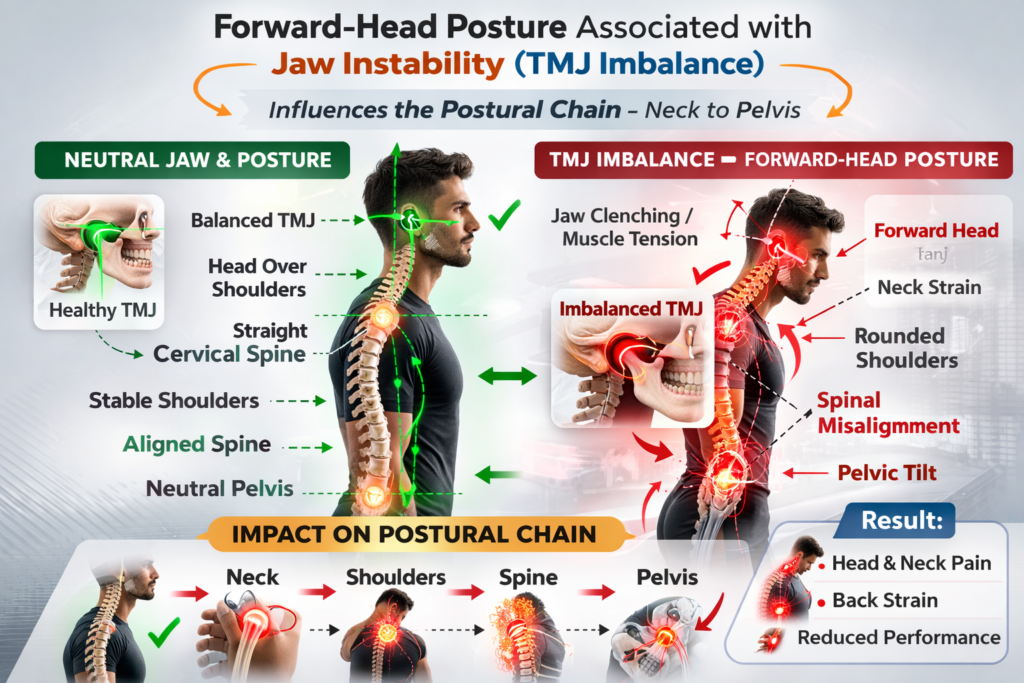
Over time, this may create postural chain imbalance, where tension in the jaw influences the head, neck, shoulders, pelvis, and even foot alignment.
Sports medicine data and systematic reviews suggest that about one-third of athletes show signs of bruxism (teeth clenching or grinding), which is higher than the general population.
Constant clenching can:
When posture shifts due to jaw imbalance, the entire kinetic chain is affected — potentially reducing strength, endurance, coordination, and reaction time.
Jaw alignment is more than “straight teeth.” It refers to how the jaw joint, disc, teeth, muscles, and posture work together during movement and breathing.
If the jaw joint is not seated in a stable, relaxed position:
This creates a postural chain imbalance, where dysfunction in the jaw influences the spine and lower body.
Studies on TMJ patients show that many also have neck and shoulder muscle tenderness, particularly in the upper trapezius and temporalis muscles. Jaw dysfunction and neck disability are frequently linked.
For athletes, poor jaw alignment can:
When jaw alignment improves, many athletes report easier breathing, improved balance, lighter neck load, and smoother movement patterns.
Inside each TMJ is a cartilage disc that acts as a cushion between the jawbone and skull. In a healthy joint, the disc moves smoothly during opening and closing.
When the disc is displaced or muscles are in constant spasm:
Neuromuscular balance means the jaw joint, disc, bite, posture, and muscles function in harmony.
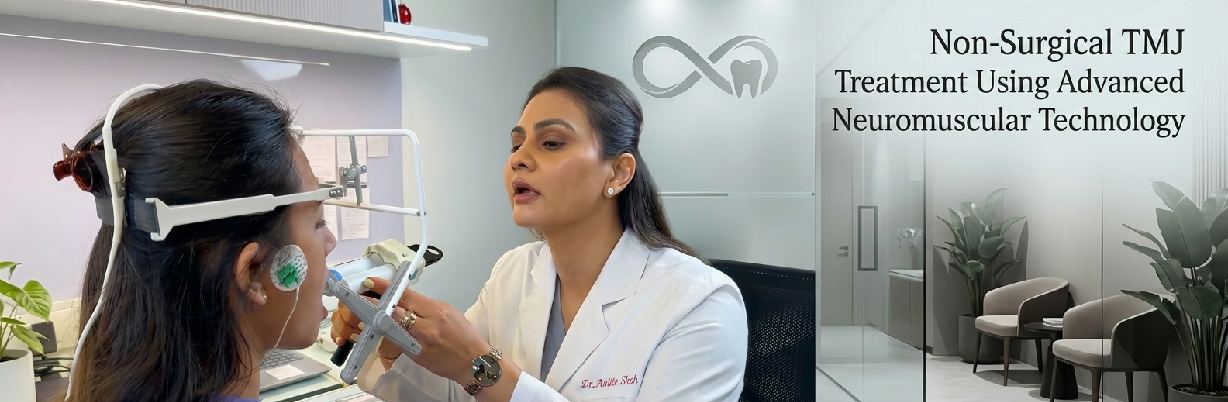
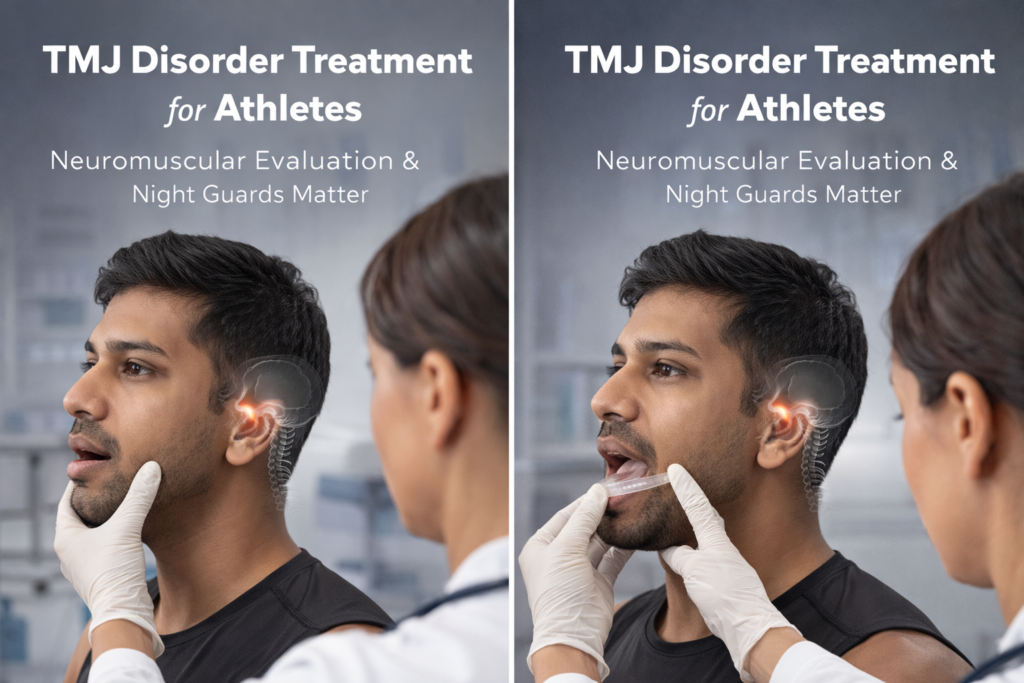
A neuromuscular evaluation assesses:
This helps design a GNM orthotic or neuromuscular night guard that supports a relaxed, stable jaw posture — rather than simply covering the teeth.
Jaw exercises and posture drills are helpful — but they do not stabilize the joint on their own.
If the disc or joint position is unstable:
Exercises help muscles cooperate once the joint is stabilized — they do not stabilize the joint independently.
When used alone → temporary relief
When combined with orthotic stabilization and specialised therapy → stable functional recovery
| Aspect | Exercises Only | Combined Therapy (Orthotic + Specialised PT + Myofunctional Therapy) |
| Focus | Relaxes muscles | Stabilises joint + retrains muscles |
| Pain Relief | Temporary | Gradual and lasting |
| Joint Stability | Not corrected | Corrected and guided |
| Clicking | May reduce temporarily | Improves as mechanics stabilise |
| Movement | Slight improvement | Coordinated and controlled |
| Recurrence | More common | Less likely |
| Best For | Mild muscle tension | Mild to complex TMJ cases |
| Outcome | Symptom relief | Functional recovery |
A neuromuscular night guard is designed to support the jaw in a relaxed and stable position during sleep, when unconscious clenching and grinding often place the highest load on the temporomandibular joint. Unlike a regular sports mouth guard that mainly protects the teeth from impact, a customised neuromuscular appliance is fabricated after detailed jaw and bite evaluation. Its purpose is to reduce excessive joint loading, calm muscle hyperactivity, and promote a more balanced neuromuscular relationship between the jaw, head, and neck. This structured stabilization supports recovery rather than simply offering surface-level protection.
You may benefit from a combined TMJ/GNM orthotic and physiotherapy plan if you:
Athletes often achieve better outcomes when:
TMJ disorder in athletes is not just about jaw pain. It can influence posture, breathing, muscle coordination, recovery, and overall sports performance. When the jaw joint is unstable, the body compensates through the neck, shoulders, and entire postural chain, affecting balance and efficiency.
A structured neuromuscular evaluation helps identify whether jaw position is contributing to performance limitations. When appropriate, a customised GNM orthotic combined with posture correction and specialised therapy can support joint stability, reduce muscle overload, and improve recovery. For athletes, long-term performance depends not only on training intensity but also on structural balance.
Yes. TMJ disorder can contribute to jaw pain, neck pain, shoulder stiffness, headaches, and postural imbalance. These factors may affect breathing rhythm, balance, endurance, and recovery.
Clenching often happens subconsciously during heavy lifting, sprinting, or stress. Over time, repeated clenching can overload the jaw joint and surrounding muscles, leading to TMJ symptoms.
No. A regular sports mouth guard mainly protects teeth from impact. A neuromuscular night guard or GNM orthotic is designed to support jaw stability and reduce muscle overload.
In many cases, yes. Jaw position influences head and neck posture. When jaw stability improves, postural chain imbalance may reduce, helping athletes move more efficiently.
Many athletes notice early improvement within 2–6 weeks, with more stable recovery over 3–6 months when following a structured treatment plan.
Exercises can support muscle coordination but do not stabilize the joint by themselves. Stable recovery usually requires joint stabilisation combined with specialised therapy.
Copyright ©2025 TMJ, Tongue Tie and Sleep Institute. All Rights Reserved.
WhatsApp us
Let Us Know How Can We Help You!
At our institute, we take pride in providing complete care for issues related to tongue tie and TMJ. To enhance your quality of life, we treat a range of ailments with state-of-the-art technology and expert care. If you’re searching for an effective tongue-tie operation option or a TMJ specialist in India, you have arrived at the right place.
A tongue tie operation or tongue tie surgery is a life-changing procedure that not only restores tongue mobility but also has a full body effect. While most people associate tongue tie with breastfeeding difficulties in infants, it can also affect speech, breathing, posture, dental health, and sleep patterns in older children and adults. By undergoing this minimally invasive fascia release procedure, patients often experience immediate improvements in functionality and overall well-being.
For individuals considering tongue tie surgery, the benefits are far-reaching:
The Temporomandibular Joint (TMJ) that is your Jaw Joint has a significant impact on one’s quality of life, as they leave the person feeling exhausted and irritable. It not only affects essential functions like chewing, speaking, yawning but also affects one’s posture, breathing and sleep. As a leading TMJ specialist in Mumbai, we offer comprehensive diagnostics and personalized treatment plans to address your unique needs.
Our approach to TMJ disorders combines state-of-the-art technology with evidence-based practices. We specialize in:
Many patients are unaware that tongue tie and TMJ disorders can also be interconnected. A restricted tongue can lead to compensatory behaviors that strain the jaw, progressing towards TMJ issues.
For newborns, a tongue tie operation is critical in supporting breastfeeding. Infants struggling to latch or feed effectively benefit greatly from a quick and safe procedure.
Adults often seek tongue tie operations for relief from symptoms such as speech impediments, TMJ pain, or even snoring. Combining tongue tie surgery with myofunctional therapy ensures optimal results.
An integral part of our treatment protocols is myofunctional therapy. Exercises used in this therapy help to strengthen and coordinate the muscles of the tongue and face. Whether you’re undergoing a tongue tie operation or being treated for TMJ issues, myofunctional therapy plays a pivotal role in ensuring lasting outcomes. Expertise and complete treatment are essential for treating TMJ issues or tongue tie. Whether you’re searching for the best tongue tie surgery options or a trusted TMJ specialist in Mumbai, we ensure personalized care and transformative results. Don’t let these conditions stop you—reach out to us today to book your consultation and start your journey toward better health and wellness.