





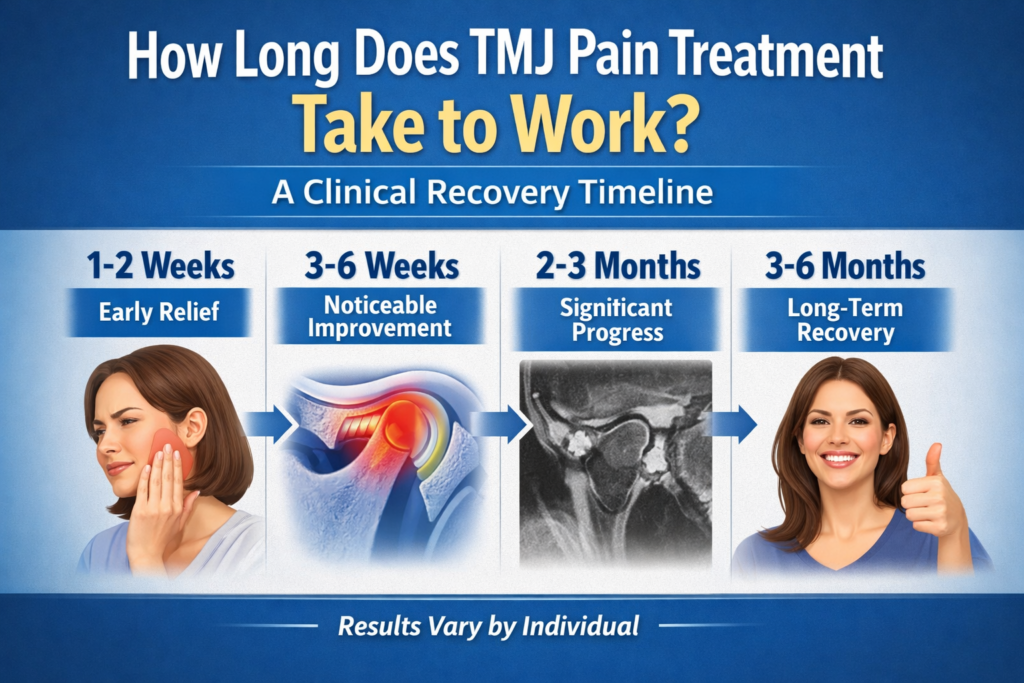
Most patients beginning structured TMJ stabilization notice measurable change within 2–4 weeks. However, meaningful functional improvement typically develops between 4–8 weeks, while long-term joint stability often requires 3–6 months of guided adaptation.
That said, TMJ recovery is not defined by a fixed calendar. It is defined by diagnosis, joint condition, neuromuscular status, and biomechanical loading patterns.
The real question is not simply, “How long does TMJ treatment take?”
It is:
What type of TMJ dysfunction is present, and how does that condition respond to stabilization?
Understanding this distinction is essential for realistic expectations.
TMJ disorders do not represent a single condition. They may include:
Each presentation responds differently.
Muscular-Dominant Dysfunction
Cases driven primarily by muscle hyperactivity often show earlier improvement because reducing abnormal muscle firing decreases pain relatively quickly.
Disc-Related Dysfunction
If disc displacement is present, adaptation takes longer. Stabilization must reduce compressive forces before coordinated motion improves.
Degenerative Joint Changes
Structural changes require longer-term load management rather than short-term correction. Expectations must shift toward stabilization rather than reversal.
Recovery timeline depends on which of these mechanisms is active – and often, multiple factors coexist.
Healing in TMJ care does not mean instant pain elimination. It means:
When dysfunction develops, muscles frequently enter a protective hyperactive state. This guarding attempts to stabilize instability but eventually produces fatigue, trigger points, and headaches.
Structured conservative management works by:
This process unfolds in phases.
As compressive forces decrease, muscle activity begins reorganizing.
During this period, patients often experience:
If muscle retraining or myofunctional therapy is incorporated, coordination improves more efficiently.
Importantly, this phase reflects structural adaptation — not temporary symptom suppression.
Diagnosis goes beyond identifying jaw pain and includes:
Advanced tools may include:
This comprehensive evaluation helps determine whether symptoms are primarily mechanical, neuromuscular, or involve nerve sensitization.
Between one and three months, mechanical efficiency improves.
Joint loading becomes more balanced, and muscle hyperactivity significantly decreases.
Patients commonly report:
Fewer headaches
Improved chewing endurance
Increased confidence in jaw movement
Reduced frequency of unpredictable pain episodes
This stage represents meaningful neuromuscular stabilization.
By three to six months, most patients achieve sustained stability.
Symptoms, if present, are typically:
The goal shifts from active correction to maintaining balanced loading patterns.
Continued orthotic compliance, stress management, and postural awareness support long-term success.
Recovery remains progressive and occasionally variable – which is expected during neuromuscular adaptation.
If significant improvement is not observed within 6–8 weeks, reassessment is clinically appropriate.
Possible reasons include:
Treatment timelines are not simply extended – they are re-evaluated based on updated clinical findings.
This diagnostic alignment is critical to predictable outcomes.
Improvement does not mean complete absence of symptoms in the early weeks.
It means:
Many patients describe a shift from constant jaw awareness to occasional awareness during high stress or fatigue.
This reflects meaningful functional control.
Surgical intervention addresses structural intra-articular concerns but does not inherently resolve neuromuscular imbalance.
Post-surgical recovery frequently requires 3–6 months and still includes rehabilitation.
For this reason, conservative stabilization is typically recommended as first-line management unless specific structural indications exist.
In structured conservative management:
These timelines assume:
When these elements align, improvement is progressive and sustainable.
TMJ recovery is not an overnight correction. It is a structured process of mechanical unloading and neuromuscular recalibration.
Patients who understand this staged progression tend to remain consistent with treatment and achieve more predictable outcomes.
Early evaluation allows for individualized stabilization planning and appropriate diagnostic alignment.
Structured, conservative management remains the foundation of responsible TMJ care.
Most patients notice early improvement within 2–4 weeks, while significant functional recovery typically occurs over 4–8 weeks. Long-term stabilization may require 3–6 months depending on the severity and cause of the TMJ disorder.
Yes. In many cases, conservative TMJ treatment such as stabilization orthotics, muscle retraining, posture correction, and stress management can significantly improve symptoms without surgery.
TMJ disorders involve joints, muscles, posture, and neuromuscular coordination. Recovery requires gradual reduction of joint stress and retraining of muscle function, which happens progressively over time.
Recovery depends on several factors, including muscle tension, disc displacement, joint degeneration, clenching habits, airway issues, posture, and patient compliance with treatment recommendations.
Yes. Some patients experience mild soreness or muscle fatigue during the early phase of treatment as the jaw muscles adapt to a new functional position.
If noticeable improvement is not seen within 6–8 weeks, reassessment may be needed to evaluate factors such as persistent joint compression, airway-related clenching, cervical instability, or disc pathology.
Yes. Stress can increase clenching and muscle tension, which may slow recovery and trigger flare-ups. Stress management is often an important part of long-term TMJ care.
Common signs of improvement include reduced pain intensity, fewer headaches, smoother jaw movement, better chewing comfort, reduced muscle tension, and fewer flare-ups.
Copyright ©2025 TMJ, Tongue Tie and Sleep Institute. All Rights Reserved.
WhatsApp us
Let Us Know How Can We Help You!
At our institute, we take pride in providing complete care for issues related to tongue tie and TMJ. To enhance your quality of life, we treat a range of ailments with state-of-the-art technology and expert care. If you’re searching for an effective tongue-tie operation option or a TMJ specialist in India, you have arrived at the right place.
A tongue tie operation or tongue tie surgery is a life-changing procedure that not only restores tongue mobility but also has a full body effect. While most people associate tongue tie with breastfeeding difficulties in infants, it can also affect speech, breathing, posture, dental health, and sleep patterns in older children and adults. By undergoing this minimally invasive fascia release procedure, patients often experience immediate improvements in functionality and overall well-being.
For individuals considering tongue tie surgery, the benefits are far-reaching:
The Temporomandibular Joint (TMJ) that is your Jaw Joint has a significant impact on one’s quality of life, as they leave the person feeling exhausted and irritable. It not only affects essential functions like chewing, speaking, yawning but also affects one’s posture, breathing and sleep. As a leading TMJ specialist in Mumbai, we offer comprehensive diagnostics and personalized treatment plans to address your unique needs.
Our approach to TMJ disorders combines state-of-the-art technology with evidence-based practices. We specialize in:
Many patients are unaware that tongue tie and TMJ disorders can also be interconnected. A restricted tongue can lead to compensatory behaviors that strain the jaw, progressing towards TMJ issues.
For newborns, a tongue tie operation is critical in supporting breastfeeding. Infants struggling to latch or feed effectively benefit greatly from a quick and safe procedure.
Adults often seek tongue tie operations for relief from symptoms such as speech impediments, TMJ pain, or even snoring. Combining tongue tie surgery with myofunctional therapy ensures optimal results.
An integral part of our treatment protocols is myofunctional therapy. Exercises used in this therapy help to strengthen and coordinate the muscles of the tongue and face. Whether you’re undergoing a tongue tie operation or being treated for TMJ issues, myofunctional therapy plays a pivotal role in ensuring lasting outcomes. Expertise and complete treatment are essential for treating TMJ issues or tongue tie. Whether you’re searching for the best tongue tie surgery options or a trusted TMJ specialist in Mumbai, we ensure personalized care and transformative results. Don’t let these conditions stop you—reach out to us today to book your consultation and start your journey toward better health and wellness.