





Orthodontic treatment has evolved significantly over the years, yet one topic continues to raise questions among patients and clinicians alike — premolar extraction braces. Many individuals undergoing braces are advised to remove premolars to create space for alignment. But an important concern often follows: can this decision affect the jaw or lead to TMJ problems?
From a clinical perspective, the answer is not a simple yes or no. It depends on how the case is evaluated, especially when factors like airway health, jaw position, and muscle balance are considered.
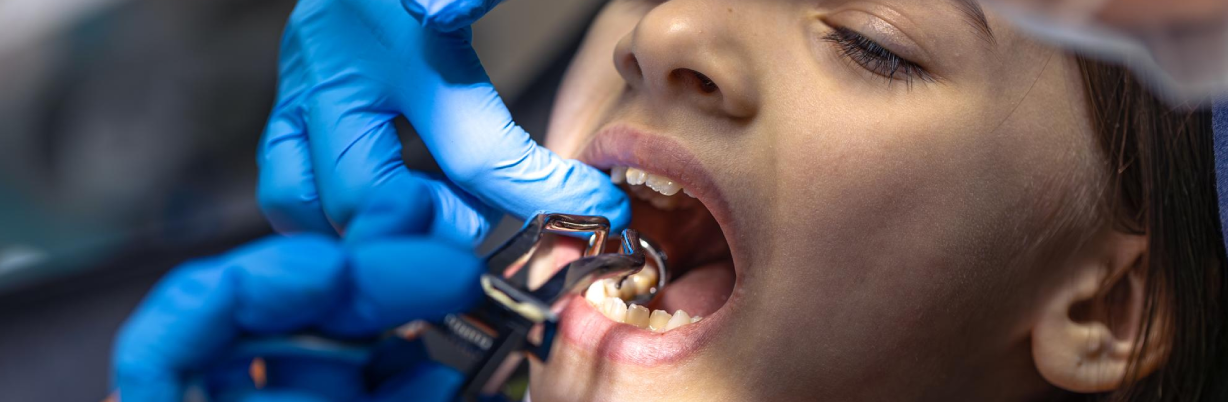
In orthodontics, crowding is a common issue. When there isn’t enough space to align teeth properly, removing premolars allows the remaining teeth to shift into a more organized position.
However, modern dentistry has started looking beyond just teeth alignment and focusing more on jaw function and TMJ treatment options. This shift helps clinicians think about long‑term comfort and stability, not just straight teeth.
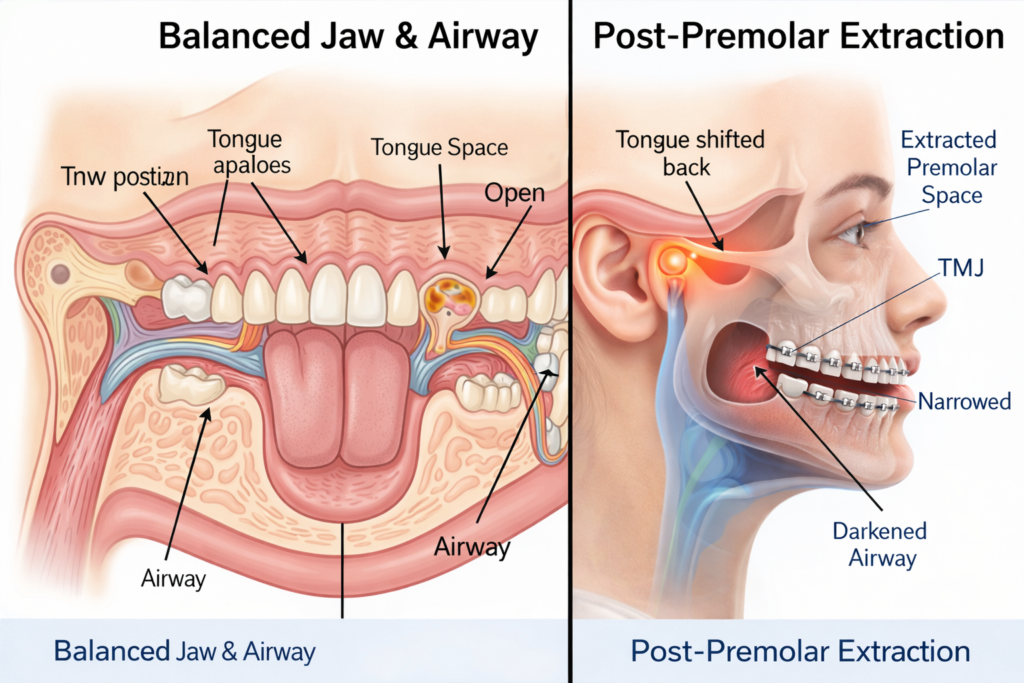
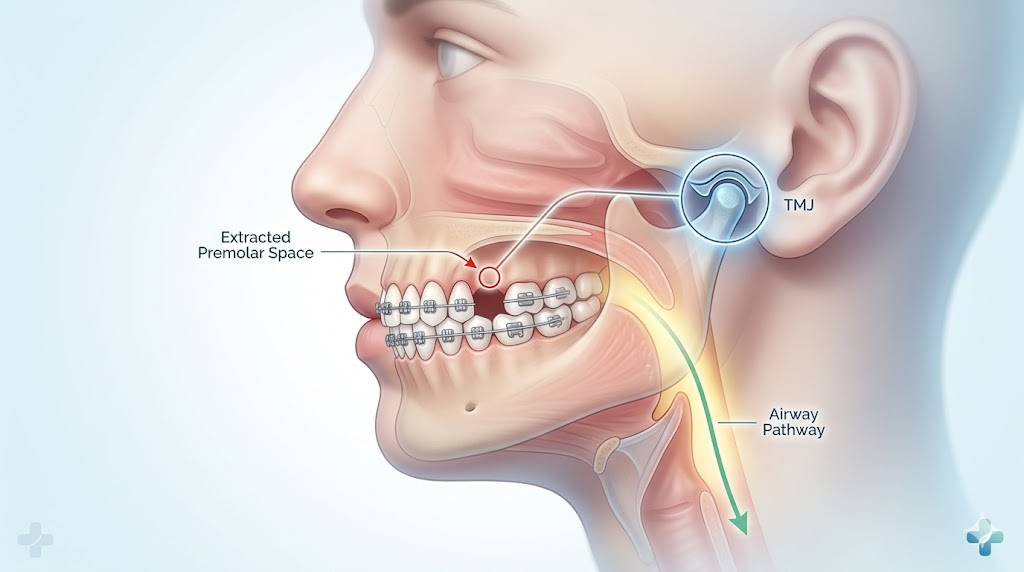
One critical aspect often overlooked in older treatment philosophies is the airway. The position of teeth directly influences jaw posture, and the jaw, in turn, affects breathing space.
When premolars are removed, the dental arch may retract. In some individuals, this can lead to:
This is where concerns about airway and braces treatment become clinically relevant.
Not every patient experiences these effects — and that is the key point.
Clinical observation suggests a pattern:
The difference lies in one crucial factor — individual anatomy and airway adaptability
If the airway remains unaffected, the jaw can adapt comfortably. But if the airway becomes compromised, the body may compensate by altering jaw position, muscle activity, and even head posture.
Over time, this compensation may contribute to tmj after braces, presenting as:
This is one of the most searched questions: “does tooth extraction cause tmj?”
The accurate answer is — not directly.
Premolar removal alone does not create TMJ dysfunction. Instead, problems may arise when:
So the issue is not the extraction itself, but how the overall system responds to it.
Modern functional dentistry emphasizes an important shift — evaluating the airway before deciding treatment.
An airway-focused assessment looks at:
If removing premolars is likely to compromise airway space, then that treatment plan may not be ideal for that patient.
This is where advanced clinical judgment plays a crucial role.
Not every patient will experience complications, but when they do occur, they are often subtle initially.
Some possible premolar extraction side effects include:
Over time, these changes may contribute to functional issues involving the temporomandibular joint.
It is important to approach this topic with balance.
Orthodontists are trained using established methods that have worked for many patients. The intention behind recommending premolar extraction braces is to achieve alignment and stability.
The shift happening today is not about blaming past methods — it is about enhancing diagnosis.
With better understanding of airway science, clinicians can now identify which cases may benefit from extractions and which may not.
An advanced assessment does not just look at teeth — it evaluates the entire craniofacial system.
A clinician trained in TMJ and airway principles will:
This comprehensive approach helps reduce the risk of developing tmj after braces and ensures that treatment supports long-term health, not just aesthetics.
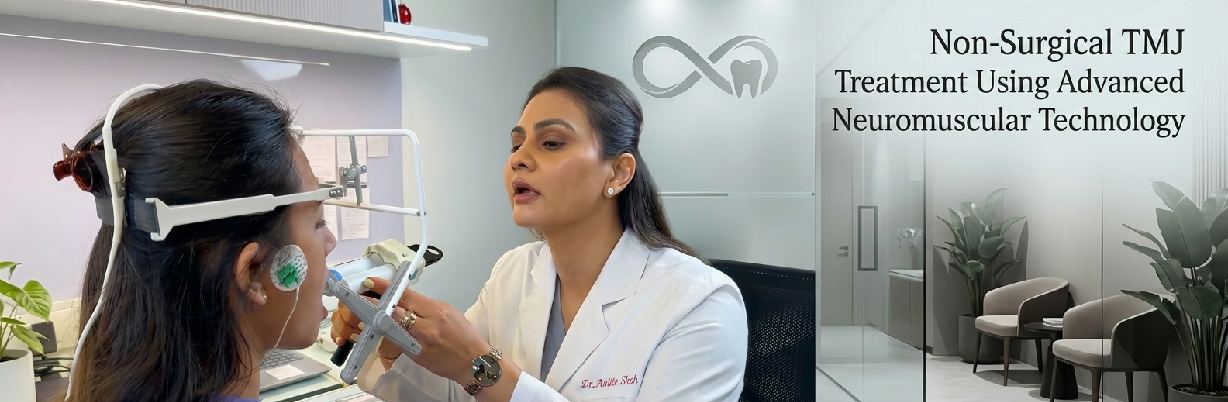
Patients seeking such evaluation often consult a qualified TMJ specialist in Mumbai for detailed assessment and personalized treatment planning.
Despite concerns, there are situations where extractions remain beneficial.
These include:
In such cases, premolar extraction braces can deliver excellent results without compromising joint health.
If you or your child is being advised extractions, consider asking:
These questions ensure that the treatment plan goes beyond cosmetic alignment.
Premolar extraction is not a one-size-fits-all decision. While it remains a valuable orthodontic tool, its impact depends heavily on individual anatomy, airway health, and functional balance.
Understanding the relationship between teeth, jaw, and breathing is essential to avoid long-term complications. With the right evaluation and planning, patients can achieve both a healthy smile and a stable jaw.
If you’re considering braces or have concerns about jaw pain after orthodontic treatment, consult a qualified TMJ expert. A detailed airway and functional evaluation can help you choose the safest approach for long-term oral health in Mumbai.
Not directly, but it can contribute if jaw position or airway is affected during treatment.
Symptoms like jaw clicking, headaches, or discomfort while chewing may indicate functional issues.
They can be in all cases, especially when airway preservation is important, but each case must be individually evaluated.
Airway assessment and jaw function analysis are critical before making the decision.
Yes, especially if compensatory patterns build over time due to bite or airway changes.
A clinician trained in TMJ and airway-focused dentistry can provide a comprehensive assessment.
WhatsApp us
Let Us Know How Can We Help You!
At our institute, we take pride in providing complete care for issues related to tongue tie and TMJ. To enhance your quality of life, we treat a range of ailments with state-of-the-art technology and expert care. If you’re searching for an effective tongue-tie operation option or a TMJ specialist in India, you have arrived at the right place.
A tongue tie operation or tongue tie surgery is a life-changing procedure that not only restores tongue mobility but also has a full body effect. While most people associate tongue tie with breastfeeding difficulties in infants, it can also affect speech, breathing, posture, dental health, and sleep patterns in older children and adults. By undergoing this minimally invasive fascia release procedure, patients often experience immediate improvements in functionality and overall well-being.
For individuals considering tongue tie surgery, the benefits are far-reaching:
The Temporomandibular Joint (TMJ) that is your Jaw Joint has a significant impact on one’s quality of life, as they leave the person feeling exhausted and irritable. It not only affects essential functions like chewing, speaking, yawning but also affects one’s posture, breathing and sleep. As a leading TMJ specialist in Mumbai, we offer comprehensive diagnostics and personalized treatment plans to address your unique needs.
Our approach to TMJ disorders combines state-of-the-art technology with evidence-based practices. We specialize in:
Many patients are unaware that tongue tie and TMJ disorders can also be interconnected. A restricted tongue can lead to compensatory behaviors that strain the jaw, progressing towards TMJ issues.
For newborns, a tongue tie operation is critical in supporting breastfeeding. Infants struggling to latch or feed effectively benefit greatly from a quick and safe procedure.
Adults often seek tongue tie operations for relief from symptoms such as speech impediments, TMJ pain, or even snoring. Combining tongue tie surgery with myofunctional therapy ensures optimal results.
An integral part of our treatment protocols is myofunctional therapy. Exercises used in this therapy help to strengthen and coordinate the muscles of the tongue and face. Whether you’re undergoing a tongue tie operation or being treated for TMJ issues, myofunctional therapy plays a pivotal role in ensuring lasting outcomes. Expertise and complete treatment are essential for treating TMJ issues or tongue tie. Whether you’re searching for the best tongue tie surgery options or a trusted TMJ specialist in Mumbai, we ensure personalized care and transformative results. Don’t let these conditions stop you—reach out to us today to book your consultation and start your journey toward better health and wellness.