







Jaw grinding during sleep is often a protective response to breathing obstruction caused by sleep apnea, where the body uses jaw movement to reopen the airway. This repeated activation can lead to muscle strain, clenching, and eventually TMJ-related symptoms if not addressed properly.
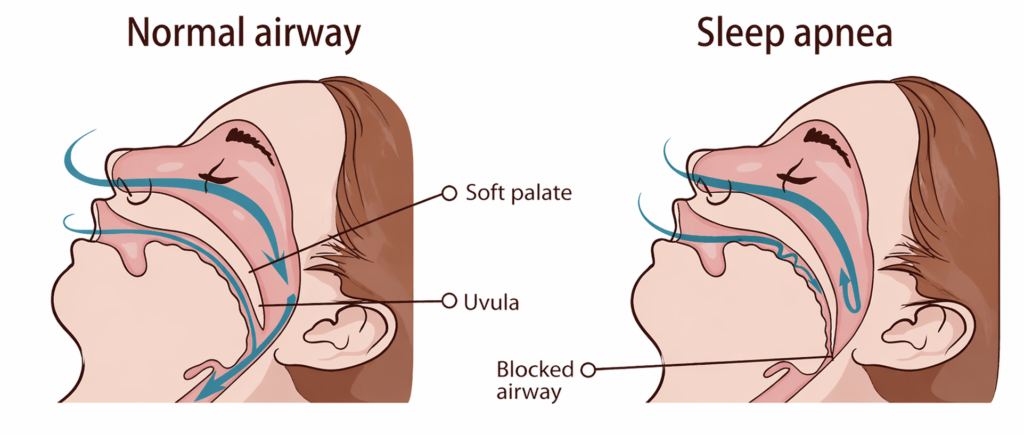
During sleep apnea, the body activates jaw muscles to move the lower jaw forward and reopen the airway when breathing becomes restricted. This is an involuntary protective reflex designed to restore airflow quickly and maintain oxygen supply during sleep. When breathing becomes unstable during sleep, the body does not remain passive. It activates a protective response designed to restore airflow as quickly as possible.
In conditions like Sleep Apnea, the airway can narrow or collapse repeatedly. Each time this happens, the body reacts by trying to reopen the airway. One of the most immediate ways to do this is by activating the jaw muscles.
The lower jaw moves slightly forward, which helps create more space for air to pass. This is not a conscious action—it is a reflex aimed at protecting breathing.
Although moving the jaw forward helps improve airflow, it is not a naturally stable position for the jaw joint or muscles. The jaw is being held in a position that requires continuous muscular effort.
As a result, the surrounding muscles begin to work harder than they are designed to during sleep. Over time, this leads to increased muscle tension and fatigue.
This is where the first shift occurs—from a breathing problem to a muscle overload problem.
When the muscles are repeatedly strained, the body initiates another level of protection. Instead of only focusing on keeping the airway open, it begins to protect the overworked muscles and joints.
This often presents as clenching or grinding, commonly known as Bruxism.
At this stage, the jaw is no longer just responding to breathing—it is reacting to internal stress within the system. The muscles tighten further, and the pressure on the joint increases.
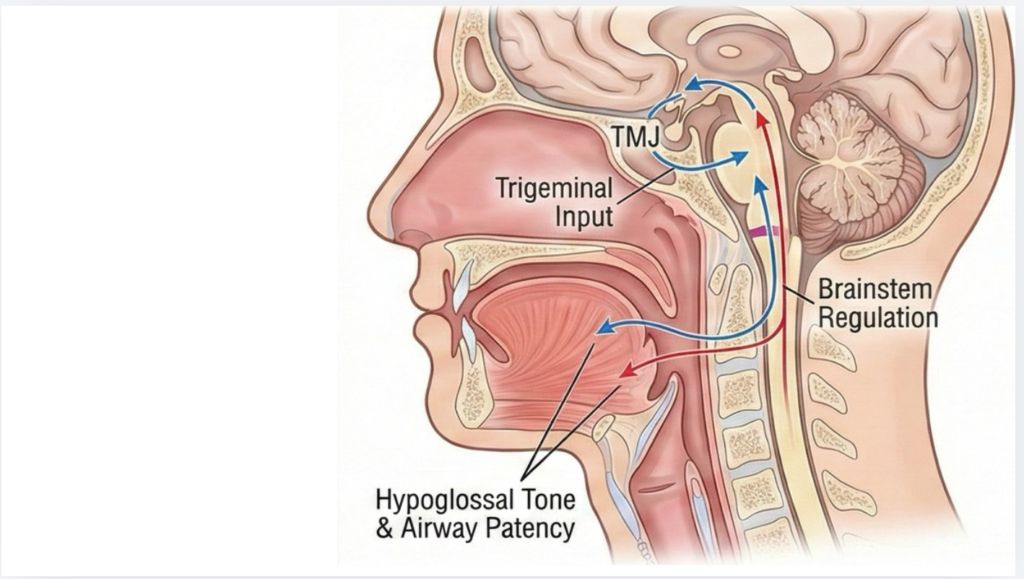
A key part of this process involves how the brainstem regulates protective responses.
Initially, the priority is to restore breathing. However, as muscle strain increases, the brainstem begins to shift its focus. Instead of prioritizing airway correction, it starts protecting the jaw and muscles from excessive load.
This shift can lead to sustained clenching patterns. The jaw remains in a guarded position, and muscle activity continues even when it is no longer helping breathing effectively.
This is an important clinical point—because it explains why grinding can persist even when the original trigger is not obvious.
Over time, continuous muscle tension and clenching begin to affect the jaw joint. The Temporomandibular Joint Disorder may develop as a result of repeated loading and altered movement patterns.
These symptoms often develop gradually, making them easy to overlook in the early stages.
Sleep apnea, bruxism, and TMJ are interconnected through a cycle involving airway instability and jaw function.
What begins as a breathing issue can gradually develop into a complex interaction affecting multiple systems.
How the Cycle Develops
Because each part influences the other, treating only one aspect may not resolve the entire problem.
Treating only teeth grinding or only sleep apnea is often incomplete.
Focusing on just one aspect does not address the full cycle of airway and jaw interaction.
Protecting the teeth alone does not reduce the need for muscle activation during sleep. Similarly, improving airflow alone may not immediately relax overworked jaw muscles.
A more effective approach considers the relationship between airway stability and jaw function.
Oral appliance therapy and Myofunctional Therapy is one such method that helps maintain airway space while guiding the jaw into a more stable and supported position during sleep.
Modern care focuses on understanding the system as a whole. This includes evaluating
airway space, jaw position, muscle activity, and how these factors interact during sleep. According to the American Sleep Apnea Association, sleep apnea remains widely underdiagnosed, which means many related symptoms may not be correctly linked. Early identification of this pattern allows for more effective and targeted management.
The relationship between sleep apnea, grinding, and TMJ is not coincidental. It represents a structured protective response – initially aimed at maintaining airway patency, and subsequently at reducing muscular overload.
Recognizing this progression allows for a shift from symptom-based management to a more integrated understanding of the underlying cycle. Such an approach supports more consistent and long-term improvements in both sleep quality and jaw function.
Jaw grinding is not always a standalone problem but often a sign of underlying airway instability during sleep. Addressing the root cause improves both sleep quality and jaw function in the long term.
The connection between sleep apnea, grinding, and TMJ is not accidental. It reflects the body’s attempt to protect itself—first by restoring breathing, and later by protecting strained muscles.
Understanding this sequence shifts the focus from treating isolated symptoms to addressing the underlying cycle, supporting better long-term outcomes for both sleep quality and jaw health.
Concerned about breathing issues, poor sleep, or enlarged tonsils?Early evaluation can help identify whether you need treatment or airway-focused care.
Consult Dr. Ankita Shah, a pediatric dentist focused on airway and functional development, with clinics in Mumbai and Delhi.
Get a personalized assessment to choose the right approach—whether surgical or non-surgical.
Book a consultation or learn more about Dr. Ankita Shah here. Call us at +91 9820737209
When airflow becomes blocked during sleep, the brain signals the jaw muscles to shift the lower jaw forward, helping reopen the breathing passage
Not always. In many cases, it is linked to airway instability and muscle response during sleep.
The brainstem regulates protective responses, shifting focus from breathing to muscle protection when strain increases.
Yes, prolonged muscle tension and clenching can contribute to TMJ symptoms over time.
The position of the jaw affects tongue placement and airway space, influencing airflow
WhatsApp us
Let Us Know How Can We Help You!
At our institute, we take pride in providing complete care for issues related to tongue tie and TMJ. To enhance your quality of life, we treat a range of ailments with state-of-the-art technology and expert care. If you’re searching for an effective tongue-tie operation option or a TMJ specialist in India, you have arrived at the right place.
A tongue tie operation or tongue tie surgery is a life-changing procedure that not only restores tongue mobility but also has a full body effect. While most people associate tongue tie with breastfeeding difficulties in infants, it can also affect speech, breathing, posture, dental health, and sleep patterns in older children and adults. By undergoing this minimally invasive fascia release procedure, patients often experience immediate improvements in functionality and overall well-being.
For individuals considering tongue tie surgery, the benefits are far-reaching:
The Temporomandibular Joint (TMJ) that is your Jaw Joint has a significant impact on one’s quality of life, as they leave the person feeling exhausted and irritable. It not only affects essential functions like chewing, speaking, yawning but also affects one’s posture, breathing and sleep. As a leading TMJ specialist in Mumbai, we offer comprehensive diagnostics and personalized treatment plans to address your unique needs.
Our approach to TMJ disorders combines state-of-the-art technology with evidence-based practices. We specialize in:
Many patients are unaware that tongue tie and TMJ disorders can also be interconnected. A restricted tongue can lead to compensatory behaviors that strain the jaw, progressing towards TMJ issues.
For newborns, a tongue tie operation is critical in supporting breastfeeding. Infants struggling to latch or feed effectively benefit greatly from a quick and safe procedure.
Adults often seek tongue tie operations for relief from symptoms such as speech impediments, TMJ pain, or even snoring. Combining tongue tie surgery with myofunctional therapy ensures optimal results.
An integral part of our treatment protocols is myofunctional therapy. Exercises used in this therapy help to strengthen and coordinate the muscles of the tongue and face. Whether you’re undergoing a tongue tie operation or being treated for TMJ issues, myofunctional therapy plays a pivotal role in ensuring lasting outcomes. Expertise and complete treatment are essential for treating TMJ issues or tongue tie. Whether you’re searching for the best tongue tie surgery options or a trusted TMJ specialist in Mumbai, we ensure personalized care and transformative results. Don’t let these conditions stop you—reach out to us today to book your consultation and start your journey toward better health and wellness.