






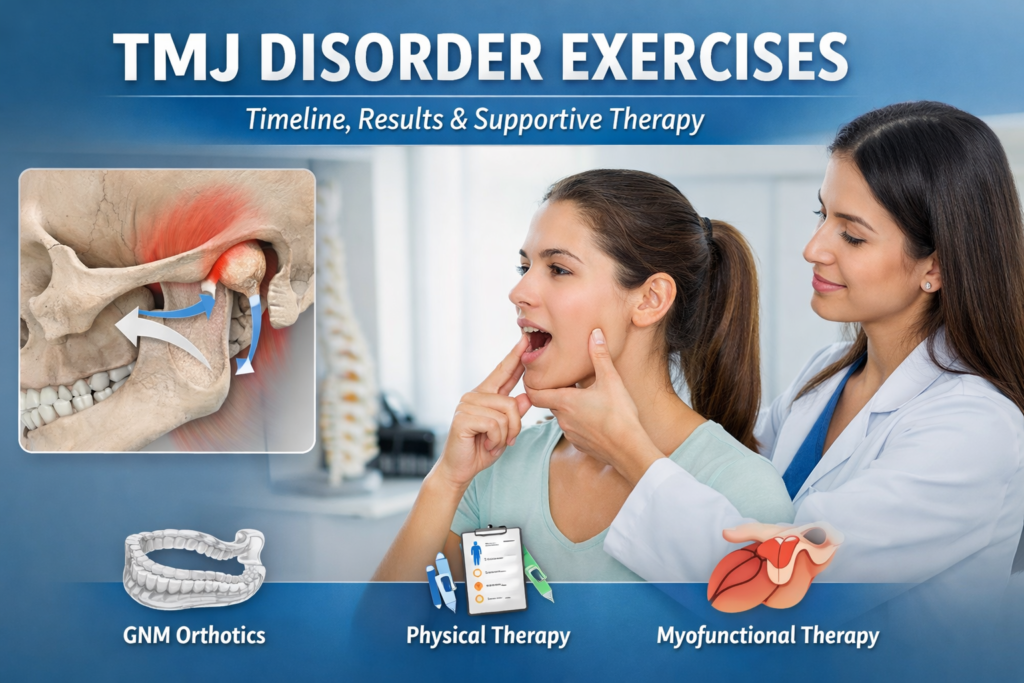
TMJ disorder exercises are supportive therapy
— they do not work effectively by themselves without specialized physical therapy and GNM orthotic stabilisation.They improve muscle behaviour and movement patterns, but long-term stability usually depends on correcting the underlying mechanical cause of the temporomandibular disorder (TMD).
Many patients notice early changes within 2–4 weeks, functional improvement over the following weeks, and more stable comfort after a few months — but only when root-cause treatment is addressed along with exercises.
The temporomandibular joint functions as a guided joint — muscles do not move randomly; they follow joint position and nerve control.
When the joint position is altered, muscles enter protective spasm.
TMJ exercises help to:
However, they do not reposition the joint, correct bite imbalance, or stabilise the disc by themselves.
Therefore:
Exercises improve muscle behaviour — orthotics stabilise joint position — specialised physical therapy restores coordinated movement — and orofacial myofunctional therapy retrains functional habits.
All four together produce stable results.
Expected Timeline of Improvement
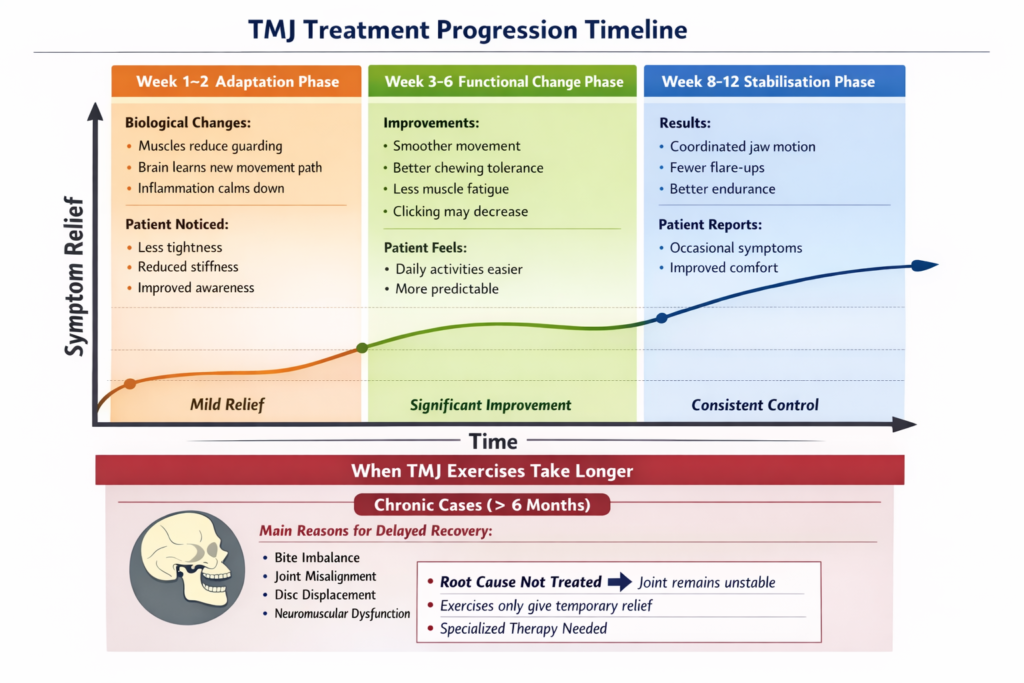
Week 1–2: Adaptation Phase
During the first two weeks, the body is not “fixing” the joint yet — it is adapting neurologically and muscularly to new movement instructions. This stage is primarily about reducing protective muscle overactivity and retraining the brain–muscle connection.
What Is Happening Biologically
1. Reduction in Protective Muscle Guarding
When the jaw joint feels unstable or irritated, surrounding muscles (masseter, temporalis, pterygoids) automatically tighten to protect it. This is called protective guarding.
In the first 1–2 weeks:
This does not mean the joint is corrected — it means the muscles are becoming less defensive.
2. Brain Begins Learning a New Movement Pathway
Chronic TMJ dysfunction creates abnormal movement patterns stored in the nervous system.
The brain essentially “memorizes” restricted or guarded openings.
During early exercise therapy:
This stage is neurological retraining, not structural repositioning.
3. Early Inflammatory Regulation
If inflammation is present due to muscle overuse:
This contributes to mild symptom relief but is not full joint stabilization.
What the Patient Notices inTMJ Disorder
Slight Decrease in Tightness
Patients often report:
However,TMJ pain levels may fluctuate during this stage.
Less Morning Stiffness
Night-time clenching may reduce slightly as muscle tension decreases, leading to:
Less soreness near temples or ears
Improved Awareness of Jaw Posture
Many patients develop:
This awareness itself contributes to long-term recovery.
Important Clinical Clarification
Relief during Week 1–2 is usually mild and inconsistent.
This phase represents:
Neuromuscular adaptation — not joint correction.
This is why exercises are considered supportive therapy and work best when combined with:
The first two weeks prepare the system for deeper correction — they do not complete it.
2. Chronic TMJ Adaptation
When symptoms persist for months, the nervous system memorises protective movement patterns.
This creates:
These cannot be reversed by stretching alone.
They require specialised physical therapy together with orthotic stabilisation and myofunctional retraining.
Typical improvement timeline: longer than early-stage cases.
3. Jaw Locking
Locking indicates mechanical obstruction rather than muscle tightness.
Exercises alone cannot overcome joint obstruction.
They are a supportive therapy in these cases and must be combined with GNM orthotic treatment and specialised physical therapy.
4. Neck and Shoulder Involvement
The jaw and cervical spine function as one biomechanical system.
When the neck compensates, multiple muscles must relearn coordination.
Best results occur when:
Exercises Alone vs Combined Therapy
| Aspect | Exercises Only | Exercises + GNM Orthotic + Specialised PT + Myofunctional Therapy |
| Main Effect | Muscle relaxation | Joint stabilisation + muscle retraining |
| Joint Position | Remains unstable | Stabilised and guided |
| Pain Relief | Temporary / fluctuating | Progressive and lasting |
| Clicking / Popping | May reduce but often returns | Often reduces as mechanics improve |
| Jaw Movement | Slightly smoother but inconsistent | Controlled and coordinated |
| Muscle Tightness | Reduces temporarily | Gradually normalises |
| Chewing Comfort | Improves mildly | Improves functionally |
| Recurrence | Common | Much lower |
| Adaptation | Muscles adapt but joint unchanged | Neuromuscular correction occurs |
| Long-Term Stability | Unpredictable | Predictable and stable |
| Suitable For | Mild muscle fatigue cases only | Mild, moderate, and complex TMJ cases |
| Goal Achieved | Symptom relief | Functional recovery |
TMJ disorder exercises are supportive therapy — not standalone treatment.
Long-term improvement depends on correcting joint mechanics and neuromuscular coordination together.
Do TMJ Exercises Alone Stabilize the Jaw?
TMJ exercises support muscle coordination, but they do not stabilize the temporomandibular joint by themselves. When used alone, exercises may provide temporary relief by reducing muscle tension. However, if the joint position remains unstable, symptoms often return.
Effective TMJ pain treatment follows the correct sequence: first stabilize the joint using GNM Orthotics, then retrain the muscles through specialised therapy. When exercises are combined with orthotic stabilization and structured TMJ care, recovery becomes stable and long-lasting — not temporary.
Most patients notice relief within 2–4 weeks and significant improvement by 8–12 weeks. Timeline depends on severity, consistency, and whether you combine exercises with other treatments like stress management or bite correction.
Yes. Research shows 70–80% of patients experience reduced clicking within 4–6 weeks of consistent exercise. While exercises can eliminate clicking in many cases, some residual sounds may persist, but pain and dysfunction improve substantially. In cases where clicking persists or symptoms are more complex, supportive therapy may be required, including orthotics and specialised physiotherapy, to stabilise the jaw and improve long-term function.
Daily practice (5–10 minutes) produces fastest results. Minimum effective frequency is 5 times per week. Exercises typically take 4–8 weeks to show results with this frequency. Inconsistent practice delays improvement.
Yes. TMJ-related headaches and ear pain can improve significantly (often a 60–80% reduction) within 8–12 weeks when treatment addresses the root cause and includes specialised physical therapy and orthotic support. Exercises alone are usually not sufficient. Headaches reduce as jaw and neck muscles are properly retrained, while ear pain improves as the jaw joint stabilises and inflammation decreases with guided therapy.
If you've done exercises consistently for 4 weeks with no improvement, or if symptoms worsen, seek professional evaluation. Additionally, jaw locking, severe pain, or neurological symptoms warrant immediate specialist assessment—don't wait.
Copyright ©2025 TMJ, Tongue Tie and Sleep Institute. All Rights Reserved.
WhatsApp us
Let Us Know How Can We Help You!
At our institute, we take pride in providing complete care for issues related to tongue tie and TMJ. To enhance your quality of life, we treat a range of ailments with state-of-the-art technology and expert care. If you’re searching for an effective tongue-tie operation option or a TMJ specialist in India, you have arrived at the right place.
A tongue tie operation or tongue tie surgery is a life-changing procedure that not only restores tongue mobility but also has a full body effect. While most people associate tongue tie with breastfeeding difficulties in infants, it can also affect speech, breathing, posture, dental health, and sleep patterns in older children and adults. By undergoing this minimally invasive fascia release procedure, patients often experience immediate improvements in functionality and overall well-being.
For individuals considering tongue tie surgery, the benefits are far-reaching:
The Temporomandibular Joint (TMJ) that is your Jaw Joint has a significant impact on one’s quality of life, as they leave the person feeling exhausted and irritable. It not only affects essential functions like chewing, speaking, yawning but also affects one’s posture, breathing and sleep. As a leading TMJ specialist in Mumbai, we offer comprehensive diagnostics and personalized treatment plans to address your unique needs.
Our approach to TMJ disorders combines state-of-the-art technology with evidence-based practices. We specialize in:
Many patients are unaware that tongue tie and TMJ disorders can also be interconnected. A restricted tongue can lead to compensatory behaviors that strain the jaw, progressing towards TMJ issues.
For newborns, a tongue tie operation is critical in supporting breastfeeding. Infants struggling to latch or feed effectively benefit greatly from a quick and safe procedure.
Adults often seek tongue tie operations for relief from symptoms such as speech impediments, TMJ pain, or even snoring. Combining tongue tie surgery with myofunctional therapy ensures optimal results.
An integral part of our treatment protocols is myofunctional therapy. Exercises used in this therapy help to strengthen and coordinate the muscles of the tongue and face. Whether you’re undergoing a tongue tie operation or being treated for TMJ issues, myofunctional therapy plays a pivotal role in ensuring lasting outcomes. Expertise and complete treatment are essential for treating TMJ issues or tongue tie. Whether you’re searching for the best tongue tie surgery options or a trusted TMJ specialist in Mumbai, we ensure personalized care and transformative results. Don’t let these conditions stop you—reach out to us today to book your consultation and start your journey toward better health and wellness.