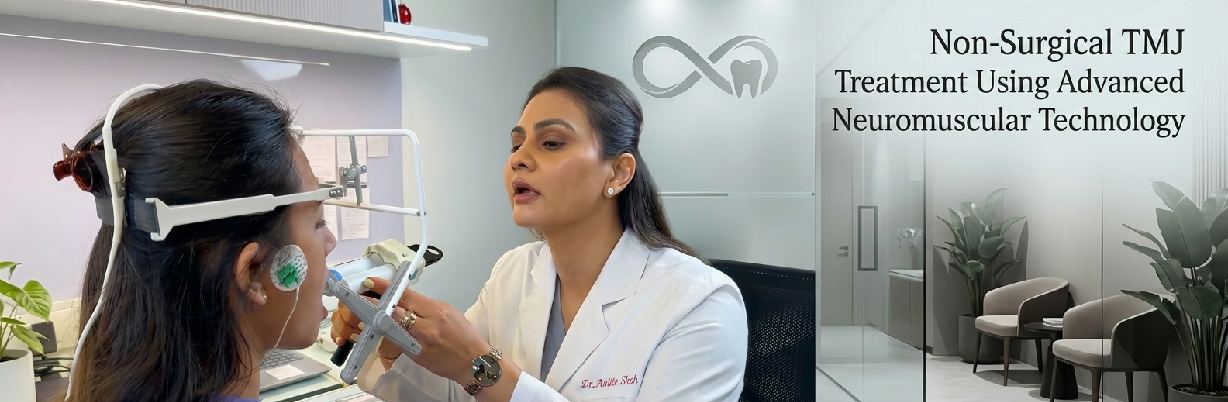







Let me ask you something. Have you been dealing with nagging neck pain or that stubborn tightness across your shoulders-the kind that no amount of stretching, massaging, or resting seems to fix? You’ve probably tried physiotherapy. Maybe you’ve adjusted your pillow, your chair, your screen height. But the pain keeps coming back.
Here’s what most people-and even many clinicians-miss: your jaw might be the one pulling the strings.
As someone who works closely with patients on airway health and oral function, I see this pattern regularly. People come to me after months-sometimes years-of unexplained neck and shoulder pain. And when we look deeper, the jaw is almost always part of the story.
Let’s talk about why.
Your temporomandibular joint (TMJ) is the small but highly important joint that connects your lower jaw to your skull, located just in front of each ear. Often described as a sliding hinge joint, the TMJ allows your jaw to move smoothly in multiple directions—up and down, side to side, and forward and backward.
It is one of the most frequently used joints in the body. Every time you chew food, speak, yawn, swallow, smile, or even breathe through your mouth, the TMJ is actively working. Because of its constant movement and complex mechanics, even minor imbalances in the jaw muscles, bite, or surrounding structures can place significant stress on the joint.
When the TMJ is not functioning properly, it can contribute to symptoms such as jaw pain, clicking sounds, headaches, facial tension, neck stiffness, and even shoulder discomfort.
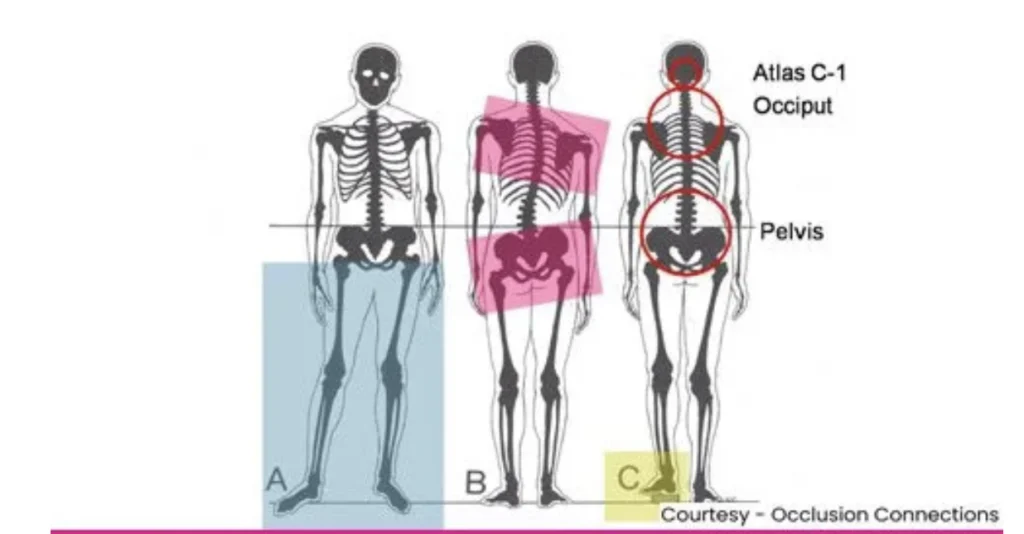
The muscles of the jaw, the muscles of the neck, and the muscles of the shoulders are all deeply interconnected-through shared nerve pathways, fascial chains, and postural compensations. When something goes wrong at the jaw, the ripple effect travels downward. And when something goes wrong in the neck or shoulders, the jaw feels it too.
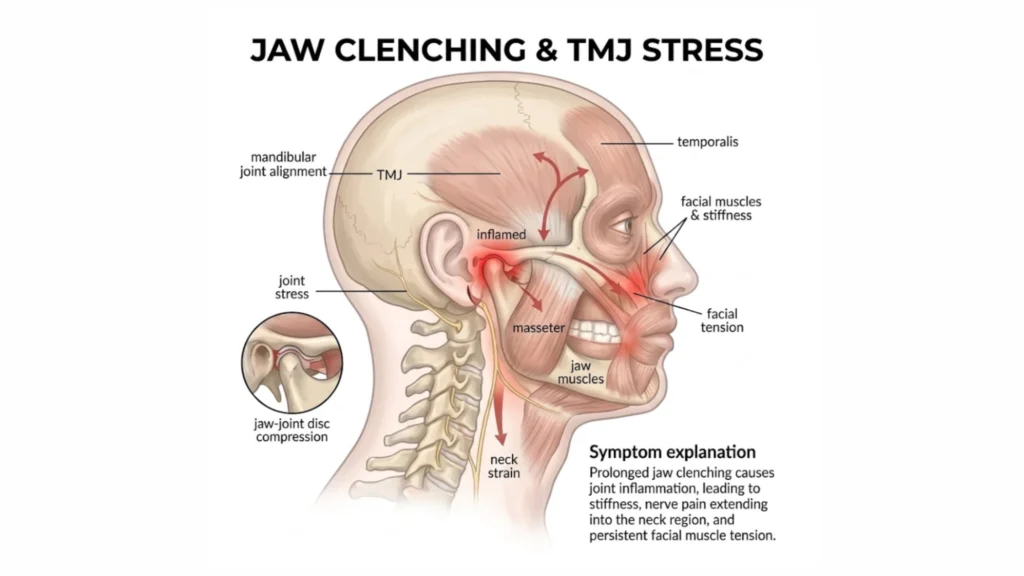
Think of your muscles as a team. When one player is injured or overworked, the others step in and carry the load. The same happens when your TMJ is under stress-from teeth grinding, jaw clenching, a bite that is slightly off, or even chronic emotional tension held in the jaw.
The surrounding muscles – particularly the sternocleidomastoid, the trapezius, and the suboccipital muscles – begin compensating. They tighten. They are fatigued. Over weeks and months, that chronic overuse translates into the neck stiffness and shoulder soreness that feels like it has no clear cause.
The trigeminal nerve is one of the largest and most far-reaching nerves in the human body. It runs through the jaw, face, temples, and connects into the cervical region. When the TMJ is inflamed or under mechanical stress, this nerve gets irritated-and that irritation does not stay put. It radiates. Patients often describe it as a deep ache running from the jaw up into the temples or down into the neck and upper shoulders.
This is why so many people with TMJ issues are misdiagnosed with tension headaches or cervicogenic pain – because the symptoms genuinely feel like they originate there.
This one surprises most people. When the jaw is not in its optimal position, the head naturally compensates. It tilts. It protrudes slightly forward. The cervical spine follows. The shoulders are round. And suddenly you have a full-body postural deviation-all starting from a joint the size of your thumb.
Forward head posture – something I commonly see in my patients with jaw dysfunction-adds significant load to the cervical spine and the muscles supporting it. Over time, this creates chronic pain not just in the neck and shoulders, but sometimes extending into the upper back and lower back as well.
Many of my patients grind or clench their teeth at night without realizing it. They wake up with a sore jaw, tight temples, or an aching neck-and they blame their pillow or their sleep position.
Bruxism keeps the muscles of the jaw, neck, and shoulders in a near-constant state of low-grade tension. There is no recovery phase. Night after night, the muscles work when they should be resting – and the cumulative effect builds into chronic pain that feels relentless and inexplicable.
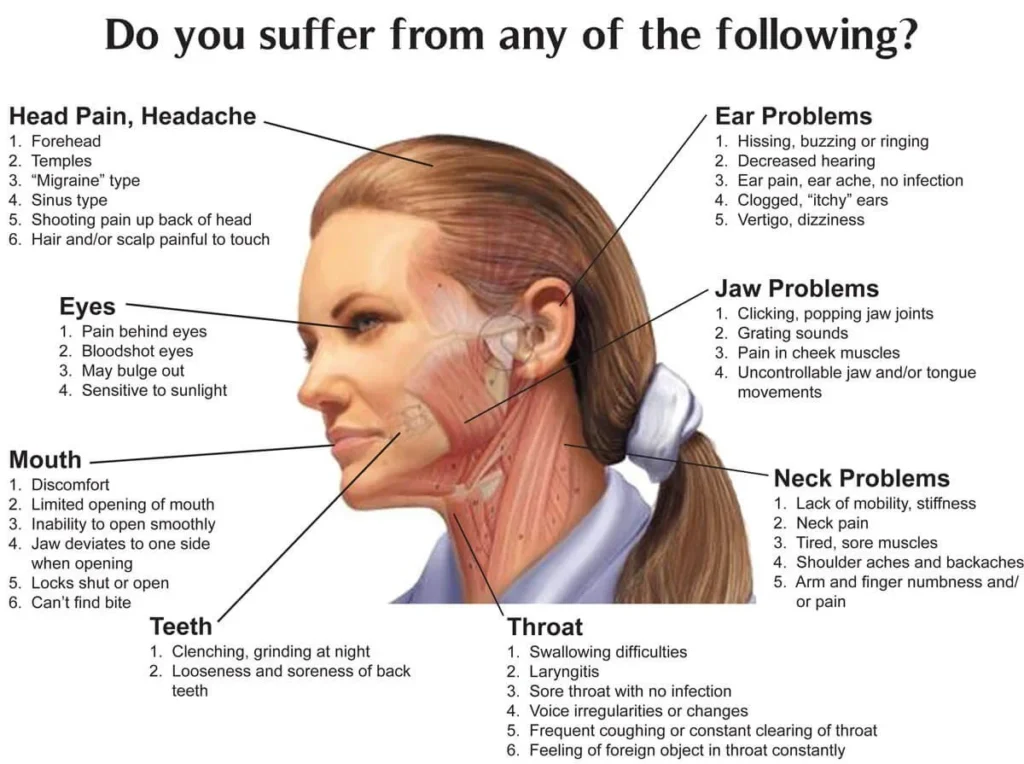
You do not need to wait for a clinical appointment to begin supporting your jaw and neck health. Here are a few approaches that genuinely help:
Slow, controlled movements can help release tension in the masseter, pterygoid, and neck muscles. Myofascial release techniques — guided by a professional — can make a real difference.
Apply a warm compress to the jaw and neck to ease tight muscles. During flare-ups, use a cold pack to help calm inflammation and reduce discomfort.
Notice how you hold your head while working, driving, and using your phone. The relationship between screen position and jaw tension is more significant than most people realise.
Many people hold chronic tension in their jaw without awareness. Diaphragmatic breathing, mindfulness, and simple jaw relaxation exercises can begin to interrupt that pattern.
When self-care is not enough — and often it is not on its own — professional intervention may be the next step. Persistent jaw pain, neck stiffness, headaches, clenching, or bite-related problems often involve deeper muscular, joint, airway, or structural issues that require targeted treatment.
Precisely calibrated oral devices that help reposition the jaw by opening the airway and thereby reduces grinding pressure, and allow the muscles to recover.
Specific exercises designed to improve jaw and cervical spine function together — not in isolation.
Manual therapy that targets the fascial connections between the jaw, neck, and shoulders to release deep-seated tension.
Helps address cervical alignment issues that may be contributing to the overall pain pattern.
In cases where structural misalignment is significant, targeted dental treatment may form part of a longer-term management plan.
If your neck or shoulder pain has persisted for more than a few weeks, if it keeps returning despite conventional treatment, or if you recognise any of the jaw-related signs above-it is time to look at the jaw as part of the picture.
What I find most often in clinical practice is this: patients have already seen multiple specialists. They have had imaging, physiotherapy, orthopaedic consultations. But no one has looked at the jaw. And that is exactly where the answer has been sitting all along.
The jaw–cervical spine–shoulder connection is not a fringe theory. It is supported by well-established anatomy and clinical evidence. Understanding it changes how we approach chronic upper-body pain entirely.
Chronic neck and shoulder pain is rarely just about posture. It is rarely just about your mattress, your ergonomic chair, or how you hold your phone. When we look at the whole system-the jaw, the cervical vertebrae, the muscles connecting them, and the nerve pathways running through all of it-we begin to see a much more complete picture.
If you have been living with unexplained neck or shoulder pain, I want you to consider this: the answer may be in your jaw.
Yes. The jaw, neck, and shoulder muscles are closely connected, so TMJ dysfunction can create muscle tension and pain in these areas.
Pain while chewing, jaw stiffness, teeth grinding, headaches, and recurring neck tension may indicate a TMJ connection.
Yes. TMJ problems can cause headaches, neck pain, ear symptoms, and muscle tightness even without jaw pain.
In many cases, yes. Correcting jaw dysfunction often reduces muscle strain in the neck and shoulders.
Treatment may include jaw assessment, GNM orthotics, splints, physiotherapy, myofascial release, and posture correction.
No. Most TMJ treatments are gentle, non-invasive, and designed to improve comfort gradually.
Some patients improve within weeks, while chronic cases may take a few months of consistent treatment.
Yes. Mouth breathing, teeth grinding, and poor oral habits can contribute to TMJ issues in children and teenagers.
WhatsApp us
Let Us Know How Can We Help You!
At our institute, we take pride in providing complete care for issues related to tongue tie and TMJ. To enhance your quality of life, we treat a range of ailments with state-of-the-art technology and expert care. If you’re searching for an effective tongue-tie operation option or a TMJ specialist in India, you have arrived at the right place.
A tongue tie operation or tongue tie surgery is a life-changing procedure that not only restores tongue mobility but also has a full body effect. While most people associate tongue tie with breastfeeding difficulties in infants, it can also affect speech, breathing, posture, dental health, and sleep patterns in older children and adults. By undergoing this minimally invasive fascia release procedure, patients often experience immediate improvements in functionality and overall well-being.
For individuals considering tongue tie surgery, the benefits are far-reaching:
The Temporomandibular Joint (TMJ) that is your Jaw Joint has a significant impact on one’s quality of life, as they leave the person feeling exhausted and irritable. It not only affects essential functions like chewing, speaking, yawning but also affects one’s posture, breathing and sleep. As a leading TMJ specialist in Mumbai, we offer comprehensive diagnostics and personalized treatment plans to address your unique needs.
Our approach to TMJ disorders combines state-of-the-art technology with evidence-based practices. We specialize in:
Many patients are unaware that tongue tie and TMJ disorders can also be interconnected. A restricted tongue can lead to compensatory behaviors that strain the jaw, progressing towards TMJ issues.
For newborns, a tongue tie operation is critical in supporting breastfeeding. Infants struggling to latch or feed effectively benefit greatly from a quick and safe procedure.
Adults often seek tongue tie operations for relief from symptoms such as speech impediments, TMJ pain, or even snoring. Combining tongue tie surgery with myofunctional therapy ensures optimal results.
An integral part of our treatment protocols is myofunctional therapy. Exercises used in this therapy help to strengthen and coordinate the muscles of the tongue and face. Whether you’re undergoing a tongue tie operation or being treated for TMJ issues, myofunctional therapy plays a pivotal role in ensuring lasting outcomes. Expertise and complete treatment are essential for treating TMJ issues or tongue tie. Whether you’re searching for the best tongue tie surgery options or a trusted TMJ specialist in Mumbai, we ensure personalized care and transformative results. Don’t let these conditions stop you—reach out to us today to book your consultation and start your journey toward better health and wellness.